How to hang a gallery wall that does not look like one
Spacing, sight lines, and why the biggest piece almost never belongs in the middle.
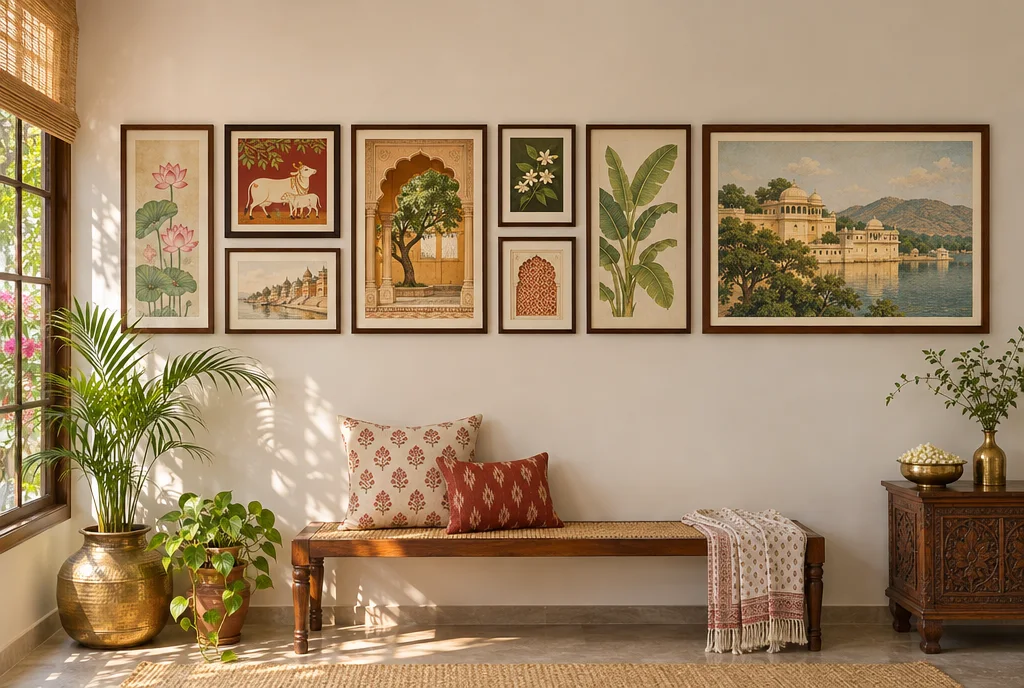
A good gallery wall looks relaxed and effortless. That look is almost always the result of a little planning. These are the rules the studio follows when we hang a group of works in a home or a hotel.
1. Plan it on the floor first
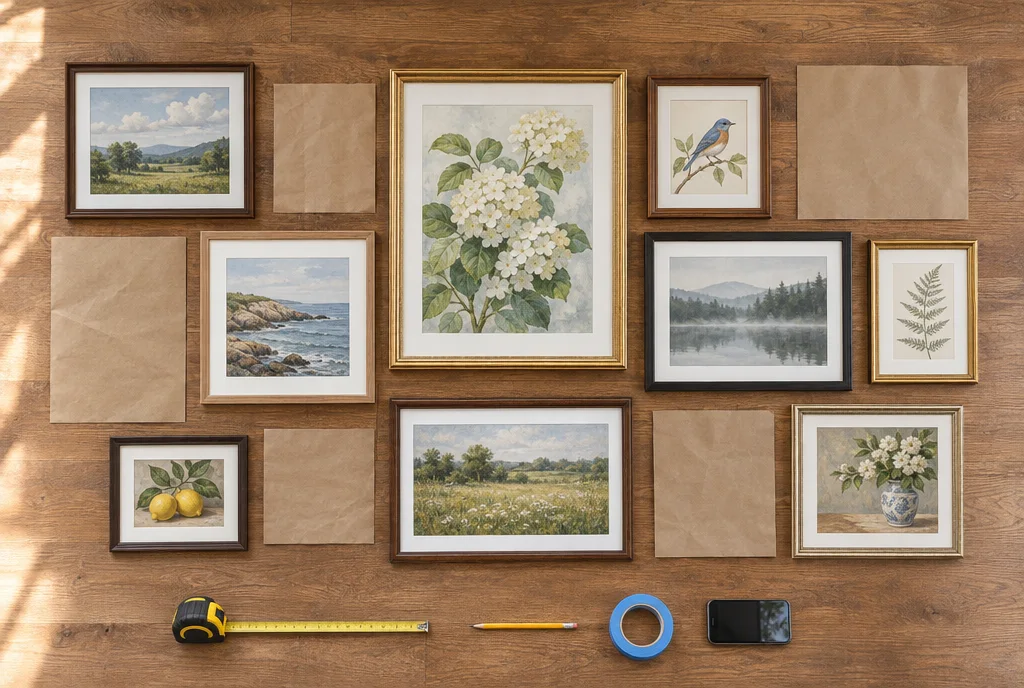
Lay every piece on the floor in front of the wall and photograph the arrangement. You will change it four times, and doing that on the floor costs nothing, while doing it on the wall costs plaster.
Once you are happy, trace each frame onto brown paper or newspaper, cut the shapes out and mark where the hook sits on each one. Tape the paper shapes to the wall. You can now see the whole layout at full size, move things around and live with it for a day before you drill a single hole.
2. Keep the gaps the same
Consistent spacing is what makes a group of different frames look like one deliberate piece. A gap of 5 to 8 cm (2 to 3 inches) between frames reads as intentional. Anything wider starts to look like a set of separate decisions.
3. Hang to a common line
Rather than centring each piece in its own space, align the group to one horizontal line — either the tops, the bottoms, or an imaginary line through the middle of the group. The eye follows that line across the wall, and the arrangement holds together even when the frames are all different.
For the group as a whole, the centre should sit at about eye level, roughly 145 to 152 cm (57 to 60 inches) from the floor, unless it hangs above furniture.
4. Do not put the biggest piece in the middle
The largest work almost never belongs in the centre. Centred, it turns the arrangement into a target, with every smaller piece circling it. Set off to one side, it anchors the group and lets the smaller pieces do something other than orbit it.
5. Give it one connecting thread
A gallery wall can mix sizes, subjects and styles, but it needs one thing in common: the same frame colour, a shared palette, or a single theme such as botanicals or landscapes. One thread is enough; more makes it look matched rather than collected.
6. Leave room to grow
The best gallery walls are never finished. Leave a little space at one edge so a new piece can join the group later without starting again.
Many prints in the AARTY shop come in sizes that work well together, and the Gallery wall sets collection brings together groups that already belong to each other.